Keepit Sellit Donateit
← Back to home

Guide

How to clear out a parent's house after they die

Clear a parent's house in this order: check who has the legal authority and find the will, secure the house and the valuables, photograph and list every item room by room, let every family member say what they want before anything leaves, settle clashes fairly, then sell, donate or dispose of the rest. Nothing has to be rushed. Work one room at a time.

Losing a parent is hard enough. Then comes the house: years of furniture, papers, photos and ordinary things, and a family that may not agree on what happens to any of it. This guide gives you a calm order to work in and a fair way to share things out. If you are wondering what to do with your parents' stuff, start with the papers and valuables in Step 3.

This is general information, not legal advice. The rules about who can deal with a house and its contents differ by country and state, so check the details with the executor or an estate lawyer.

Step 1: Check who is in charge and find the will

The person with the legal right to deal with the house and its contents is usually the executor named in the will. If there is no will, the law or a court usually decides who acts as administrator. Until you know who that is, other family members should not take, sell or give away anything of value.

  • Look for the will, and any separate written list of who should receive particular items. People often keep these in a desk, a safe or with a lawyer.
  • Ask the executor whether anything has a deadline, such as a rental lease ending or the house being sold.
  • Spoken promises ("Mum said I could have the ring") may not be binding unless they were written down. Many families choose to honour them anyway, so talk about them openly.

Step 2: Secure the house and the valuables

  • Collect the keys and note who has copies.
  • Tell the home insurer that the house is empty. Some policies limit cover for an empty home.
  • Redirect the mail and cancel deliveries and subscriptions.
  • Move jewellery, cash and small valuables somewhere safe, and write down what you moved and who is holding it.
  • Take dated photos of every room as it is, before anyone moves anything.

Step 3: Find the important papers first

Before you deal with the furniture, find the things that are hard to replace. Keep them together, and do not throw any paperwork away until the executor says it is safe.

  • The will and any trust papers
  • Property deeds, or the rental or lease agreement
  • Bank, pension, insurance and tax records
  • Passports, birth and marriage certificates and other ID
  • Phones, computers and tablets, and any list of passwords

Step 4: Photograph and list everything, room by room

A clear list is the foundation of a fair process. Everyone, including relatives who live far away, can see exactly what there is.

  • Work one room at a time. Start with the least emotional room, such as a spare room or the garage, to build a rhythm.
  • Take one photo of the whole item, and a close-up of any mark, label or damage.
  • Give each item a short title and note where it was found.
  • Put anything that might be valuable (jewellery, art, antiques, instruments, collections) in a separate group to be valued later.
  • A spreadsheet or a shared photo album will do. An app like Keep it, Sell it, Donate it handles the photographing, the list and the voting in one place.

Step 5: Let everyone say what they want before anything leaves

Many family arguments start when one person takes something early. A simple rule helps: nothing leaves the house until everyone has seen the list and had a chance to speak. Families commonly use one of these approaches.

  • Everyone marks what they want first. Compare the marks. Most items turn out to be wanted by one person, or by nobody.
  • Take turns choosing. Draw lots for who goes first, then alternate picks.
  • Discuss the clashes separately. Items that more than one person wants are talked through after everything else is settled.
  • Share copies. Photographs, scans and recordings let several people keep a memory of the same thing.
  • Include everyone. Relatives overseas or in another city can take part through photos.

For a fuller comparison of methods, see our guide to dividing a parent's belongings between siblings.

Step 6: Settle disagreements fairly

Sooner or later two people will want the same item. Try these in order.

  1. Ask each person why it matters to them. Often one person cares about the memory and the other about the object.
  2. Look for a swap. One person takes it and the other chooses something of similar meaning or value.
  3. Take turns. The item goes to one person for a set time, then to the other, if that is practical.
  4. Make a copy or take a photograph so both people keep something.
  5. If both agree, sell it and split the money.
  6. Ask a neutral person to make the final call, such as the executor, a trusted relative or a mediator. In the app this person is called the Decider.

A simple majority is rarely a good way to settle a sentimental item, because the person who wants it most can be outvoted. Agree in advance who has the final say.

Step 7: Sell, donate or dispose of the rest

  • Get valuables looked at first. Antiques, jewellery, art, instruments, watches and collections can be worth more than they look. Get a valuation, or at least a second opinion, before selling to a house-clearance buyer.
  • Sell what has value. Furniture and household items can be sold online or locally. For a whole house, an estate-sale company may be easier.
  • Donate what is usable. Many charities collect from the door. Keep a list of what you gave. Tax treatment differs by country, so ask a tax adviser if it matters.
  • Consider hiring help for the heavy work. See our guide to estate cleanout services.
  • Dispose of the rest properly. Hire a skip or a clearance service if you need one, and take paint, chemicals, old medicines and batteries to a proper disposal point.

Step 8: Pace yourselves

It is normal for this to take weeks or months. Short sessions, one room at a time, with regular breaks, are easier on everyone than a marathon weekend. Agree who will tackle the hardest rooms, and stop when it gets too heavy. Nobody has to do it all at once.

Step 9: Keep a record

Write down what each person received, what was sold and for how much, what was donated, and what was thrown away. A clear record protects everyone later if a question comes up. Keep it with the will and the other estate papers. In the app, you can save PDF reports for this: a Keep Inventory, Sell List, Donation Manifest, Discard Record and Executor Summary.

Quick checklist

  • Confirmed who the executor or administrator is
  • Found the will and any written list of who gets what
  • Secured the house, valuables and keys, and told the insurer
  • Found and stored the important papers
  • Photographed and listed every item, room by room
  • Let every family member say what they want
  • Settled clashes with a fair method or a Decider
  • Valued anything that might be valuable before selling
  • Sold, donated or disposed of the rest
  • Kept a written record of every decision

Make it easier

Do steps 4 to 9 together in one app

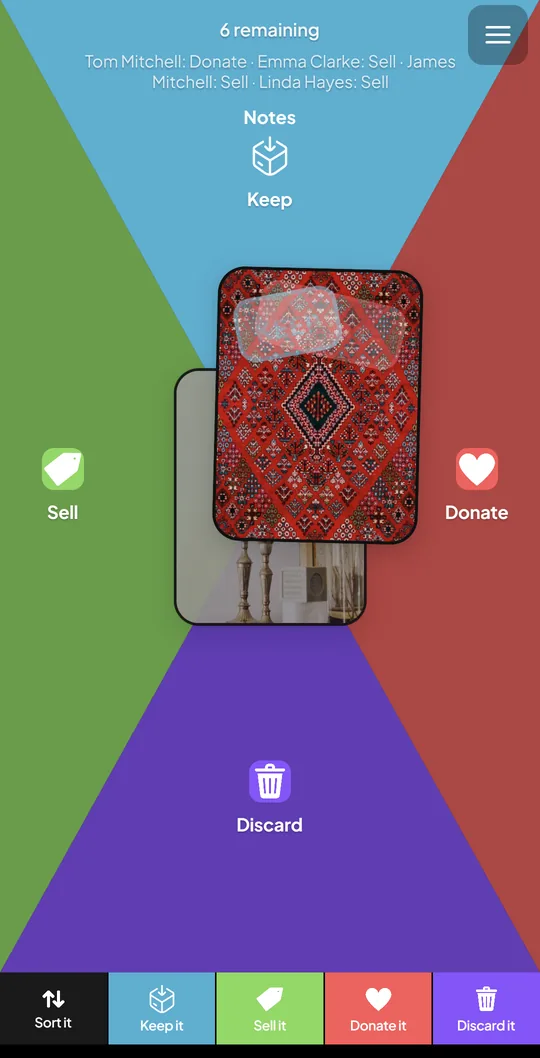
Keep it, Sell it, Donate it is a free app where you photograph each item, everyone votes Keep, Sell, Donate or Discard, and clashes are flagged for you to talk through or hand to a Decider. It also tracks sales and saves your records as PDFs.

Get it onGoogle Play Coming soon to theApp Store
Swipe screen with a photo of a rug and zones for Keep, Sell, Donate and Discard

Frequently asked questions

How long should I wait before clearing out a parent's house?

There is no single rule. Many families wait until the legal basics are settled and they have had time to grieve. Deadlines such as a rental lease, a house sale or ongoing costs can set the pace, so ask the executor or an estate lawyer if any apply.

Who has the right to clear out a deceased parent's house?

Generally the executor named in the will, or an administrator appointed if there is no will. Other family members should not remove or sell items until that person agrees. The rules differ by country and state.

Should I get things valued before selling them?

Yes, for anything that might be valuable, such as antiques, jewellery, art, instruments, watches and collections. A house-clearance buyer may not offer a fair price, so get a valuation or a second opinion first.

What should I do if my siblings and I disagree about who gets what?

Ask each person why the item matters, look for a swap or a turn-taking arrangement, and share copies or photographs where you can. If you still cannot agree, ask a neutral person such as the executor or a mediator to make the final call. Agree who that is before you start.

What is the easiest way to include family who live far away?

Photograph every item and share the list, so everyone sees the same thing and can say what they want from their own phone. An app like Keep it, Sell it, Donate it lets each person vote on every item from anywhere.

How do I start cleaning out a parent's house after death?

Start by confirming who is in charge and finding the will, then secure the house and valuables, find the important papers, and only then begin listing and sorting items room by room. Take it one room at a time, and do not rush.

Should I hire an estate cleanout service or do it myself?

If the home is small and family can help, doing it yourself keeps control of every item. If the home is large, family live far away or there is a deadline, hiring help can make sense. Many families sort keepsakes and valuables themselves and hire a company for the heavy work.