Keepit Sellit Donateit
← Back to home

Guide

How to divide a parent's belongings between siblings fairly

The fairest way to divide a parent's belongings is to agree the rules before anyone chooses. Check for written wishes, list and photograph every item so everyone sees the same thing, let each person say what they want, use a method everyone accepts (taking turns, marking what you want, or a vote), and agree who makes the final call when two people want the same item.

Most families do not fight over money. They fight over a clock, a quilt or a set of cups, because those things carry memories. A fair process protects the relationships as much as the belongings. This guide sets out how to build one.

This is general information, not legal advice. If there is a will, the executor and the will come first, and the rules differ by country and state. For the practical side of emptying the house, see our guide to clearing out a parent's house.
Step 1: Check for written wishes

Start with what your parent wanted. Look for a will, and for any separate written list or letter saying who should have particular items. Where these exist, the executor normally follows them, and the rest of this guide applies to everything they do not cover.

  • Spoken promises ("Dad said I could have the watch") may not be binding unless they were written down. Many families honour them anyway, so bring them up openly and early.
  • If an item is already covered by the will, take it out of the pile so it does not become part of the argument.

Step 2: Agree the rules first

Agreeing how you will decide, before anyone has chosen anything, removes most of the arguments later. Write the answers down and share them with everyone.

  • Who has the final say when two people want the same thing? This could be the executor, an eldest or neutral sibling, or a mediator.
  • Does anything leave the house early? A good rule is that nothing is taken until everyone has seen the list.
  • Does value matter, or just meaning? See Step 6.
  • What is the deadline? An open-ended process drags on and breeds resentment.
  • What happens to leftovers? Usually they are sold or donated, with the money shared or given to a cause your parent cared about.

Step 3: List and photograph every item

Fairness needs everyone to see the same thing. Work room by room, take a clear photo of each item (plus a close-up of any marks or labels), give it a short title, and put anything that might be valuable in its own group. A shared photo album or spreadsheet works. An app like Keep it, Sell it, Donate it builds the list as you photograph, so every sibling can see it from their own phone.

Step 4: Pick a method that suits your family

There is no single correct method. These are the ones families use most. Many mix two: mark what you want first, then use another method for the clashes.

Take turns choosing

How it works: Draw lots for who goes first, then alternate picks. Reverse the order each round so the first picker does not always win.

Best when: everyone can join in person or on a call.

Watch out: it is slow for a whole house.

Mark what you want

How it works: Everyone marks the items they want (coloured stickers, or a shared photo list) before anything is taken. An item marked by one person goes to them. Clashes are handled separately.

Best when: there are many items and most will not clash.

Watch out: people can mark everything, so ask for a reason or limit the marks.

Family auction with pretend money

How it works: Give each person the same number of points. Everyone bids points on the items they want, and the highest bid wins.

Best when: siblings value things very differently.

Watch out: some people dislike putting a number on memories.

Vote on each item

How it works: Each person votes Keep, Sell, Donate or Discard, and says whether they personally want it. One person who wants it gets it. Two or more people wanting it is a clash.

Best when: siblings live far apart, or there are hundreds of items.

Watch out: agree how clashes are settled before you start.

Share copies where you can. Scanned photos and letters, filmed recordings and photographs of objects let several people keep the same memory. This does not work for a single object, but it takes a lot of pressure off the rest.

Step 5: Handle the items everyone wants

Some things will be wanted by more than one person: a ring, a clock, a painting, family photographs. Try these in order.

  1. Ask each person why the item matters. One may care about the memory and another about the object.
  2. Look for a swap. One person takes the item, and the other chooses something of similar meaning or value.
  3. Take turns. The item goes to one person for a set period, then to the other, if that is practical.
  4. Share a copy or a photograph so both keep something.
  5. Sell it and split the money, if both agree.
  6. Ask the agreed final decision-maker to decide. In the app this person is called the Decider.

Do not split a matching set (cutlery, a pair of vases, a set of books) unless everyone agrees. Families often find that a set means more kept together.

Step 6: Decide how much value matters

Families handle this in two main ways, and either can be fair if everyone agrees to it in advance.

  • Meaning first. Items are shared out by what matters to each person, and nobody counts the money. This works well when the belongings are mostly everyday things and the siblings trust each other.
  • Roughly equal value. Valuables are appraised first, then shared so each person ends up with a similar total. This is worth considering when there are a few high-value items, because it avoids later arguments about who "got more".

Family heirlooms and family heirloom antiques, such as a grandfather clock, a silver service or an old painting, are the items most worth valuing first. If value matters, get antiques, jewellery, art, watches and collections valued before you divide anything. A sale or a share-out based on guesses is a common source of resentment.

Step 7: Include siblings who live far away

A sibling in another city or country is the person most likely to feel overlooked. Share the full photo list, give a clear window (for example two weeks) to say what they want, and use a video call to talk through the clashes. Agree who pays to ship or collect items before anyone chooses, so that a far-away sibling is not quietly priced out.

Step 8: If it gets heated

  • Take a break. Stop for a day or a week. Arguments about belongings are often really about grief.
  • Bring in a neutral person. A mediator, a senior move manager or a trusted family friend can calm things down and keep the process moving.
  • Remember the last resort. If one object is causing serious conflict, selling it or donating it to a cause your parent cared about can end the dispute. Agree this together rather than doing it to someone.
  • Get advice on anything legal. If someone has removed valuable items without the executor's agreement, or you disagree about what the will means, speak to an estate lawyer.

Step 9: Write down what was agreed

Keep a simple record of who received what, what was sold and for how much, and what was donated. Share it with every sibling and keep it with the estate papers. It prevents "I thought you said" arguments months later. In the app you can save PDF reports for this: a Keep Inventory, Sell List, Donation Manifest, Discard Record and Executor Summary.

Quick checklist

  • Checked the will and any written list of wishes
  • Agreed the rules and who has the final say, in writing
  • Listed and photographed every item
  • Shared the list with every sibling, near or far
  • Chosen a method (or a mix) everyone accepts
  • Valued anything that might be valuable
  • Settled clashes using the agreed rules
  • Sold or donated the leftovers
  • Written down who received what

Make it easier

Let everyone vote from their own phone

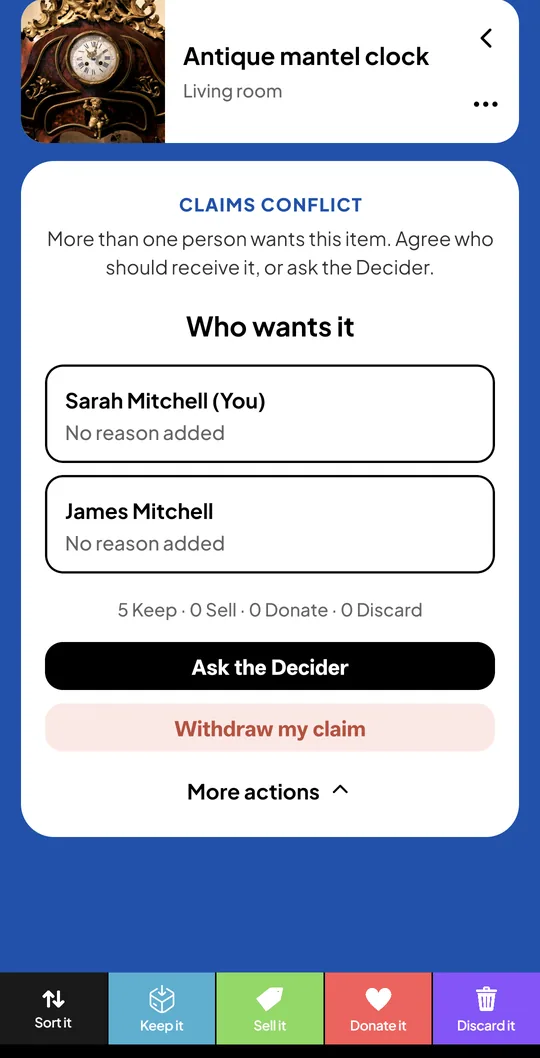
Keep it, Sell it, Donate it lets every sibling vote on every item from anywhere. If one person wants an item, they get it. If two or more do, the app flags a Claims Conflict so you can talk it through or ask the Decider. It is free to start.

Get it onGoogle Play Coming soon to theApp Store
Claims Conflict screen for an antique mantel clock showing two people who both want it

Dividing inheritance among siblings: where this guide fits

This guide is about the belongings: furniture, jewellery, photographs and keepsakes. If you are dividing inheritance among siblings more broadly, the belongings are usually the hardest part emotionally, so they are worth settling first. Money and accounts are normally handled by the executor under the will. For a shared house or land, see our guide to how to divide a house between siblings.

Frequently asked questions

What is the fairest way to divide a parent's belongings between siblings?

Agree the rules before anyone chooses, list and photograph every item so everyone sees the same thing, and use a method all siblings accept, such as taking turns, marking what you want or voting on each item. Decide in advance who makes the final call when two people want the same thing.

Should siblings receive items of equal value?

It depends on your family. Some families share by meaning and do not count the money. Others get valuables appraised and aim for a similar total each. Either can be fair if everyone agrees before the dividing starts.

What if a sibling takes things before everyone has agreed?

Raise it calmly and ask for the items to be returned or added to the list so they can be dealt with fairly. If valuable items have been removed without the executor's agreement, speak to the executor or an estate lawyer.

What if our parent promised me something but it is not in the will?

Spoken promises may not be binding unless they were written down. Many families choose to honour them anyway. Tell your siblings about the promise early and openly so it can be discussed before the dividing starts.

Can we divide belongings without meeting in person?

Yes. Photograph every item, share the list, and let each sibling say what they want from their own phone. Use a video call for the items more than one person wants. An app like Keep it, Sell it, Donate it lets everyone vote from anywhere.

How do you divide inheritance fairly?

Start with what the will says and who the executor is. Then agree rules for what is left, such as who has the final say, list and photograph every item, and use a method everyone accepts. Money, property and belongings are often handled separately.

How to split inheritance when siblings disagree?

Pause, hear each person out, and look for a swap, taking turns, a copy or a sale and split. Splitting inheritance with siblings goes best when you agree in advance who has the final say. If you still cannot agree, bring in a mediator, and speak to an estate lawyer about anything legal.

How do you divide an estate among siblings?

Follow the will first. Anything it does not cover is usually shared by agreement. Value anything that might be valuable, list every item so all siblings see the same thing, and use a fair method such as taking turns or voting. The executor normally handles money and property.

What is the best way to divide an estate between siblings?

The best way to divide an estate between siblings is to follow the will first, then agree the rules for everything else before anyone chooses. That is how to divide an estate between siblings without turning it into a fight: a shared list, a fair method and a decision-maker everyone trusts.

How do you divide estate jewelry among siblings?

Photograph each piece and have valuable items appraised. Then use a method everyone accepts, such as taking turns, or let each person mark what they want. Where two people want the same piece, look for a swap or ask the agreed decision-maker. Do not split a matching set unless everyone agrees.

How to divide family heirlooms fairly?

Photograph each heirloom, let everyone say what they want and why, and use an agreed method. Sentimental pieces often matter more than valuable ones, so hearing the reasons helps. Share copies or photographs where several people want the same memory.