Keepit Sellit Donateit
← Back to home

Guide

How to donate household items: what charities take and how pickup works

To donate household items, check what your chosen charity accepts, clean and sort your items, then drop them off or book a household donation pickup. Charities generally take clean, working and complete furniture, kitchenware, small appliances, linens and tools, and they usually cannot take broken, stained or recalled items.

Donating is the easiest way to clear a house and help someone else. The tricky parts are knowing what charities will actually accept and how to get big items out of the house. This guide covers both.

This is general information. What each charity accepts, and whether pickup is available, differs by location, so check directly with them.

Step 1: Decide: sell or donate

For decluttering, sell or donate is a question of value against effort. A quick rule: if an item is worth more than the time it takes to list, photograph, answer questions about and hand over, sell it. If not, donate it. Valuable pieces, such as antiques, jewellery or a good set of tools, are worth a quick look at the market first. See our downsizing checklist for a room-by-room way to decide.

Step 2: What charities usually take

When you donate household items, or donate household goods such as furniture and kitchenware, charities generally want things that are clean, working and complete. Typical examples that are welcome include:

  • Furniture in good condition, such as tables, chairs, shelves and bed frames
  • Kitchenware, crockery, glasses and cookware
  • Small appliances that work
  • Linens, towels and curtains in good condition
  • Lamps, mirrors, picture frames and home décor
  • Tools, garden equipment and sports gear in good condition
  • Books, games and toys that are complete and clean

Each charity has its own list, so check before you load the car. Some places also run a specialist service for particular items, such as furniture.

Step 3: What to keep out

  • Items that are broken, stained, smelly or missing parts
  • Used mattresses and pillows, which many charities cannot accept
  • Items that have been recalled for safety reasons
  • Paint, chemicals, batteries and other hazardous items
  • Anything that could not be sold in a shop if you were buying it

For items that cannot be donated, see our guide to getting rid of old furniture for disposal options.

Step 4: Kitchen items and appliances

If you want to donate kitchen items, a few rules help.

  • Wash everything, and make sure sets are complete (for example four plates and four bowls together).
  • Leave out chipped, cracked or very worn dishes and warped or scratched pans.
  • Wrap or box knives safely, and say so on the box.
  • Check that small appliances work, with their cords and parts, and clean them well.
  • Keep out anything with exposed wiring or missing safety parts.

Step 5: Prepare your donation

  • Clean and sort items by type: kitchen, linens, furniture and so on.
  • Pack small items in boxes or bags, and label them.
  • Photograph everything and keep a list of what you are giving.
  • Check each piece once more for personal papers, photographs and valuables.

Step 6: Arrange a pickup

Many charities accept household good donations at their shops, and many offer household donation pickup, which saves you a trip, especially for furniture and bulky goods. Salvation Army household pickup is available in many areas, as are pickups from other charities, but whether you can book one, and what they accept, depends on where you live. Check each charity's website or call to find out.

  • Ask what they accept and what they do not, before you book.
  • Ask how to prepare items: kerbside, front door or garage.
  • Make sure the path is clear and the items are ready on the day.
  • If you cannot book a pickup, ask about drop-off points or schedule a car trip.

Other places that may welcome household goods include shelters, community groups, schools and local reuse centres. Ask first, and do not leave items outside a closed shop or a donation bin if it is full or the area asks you not to.

Step 7: Keep a record

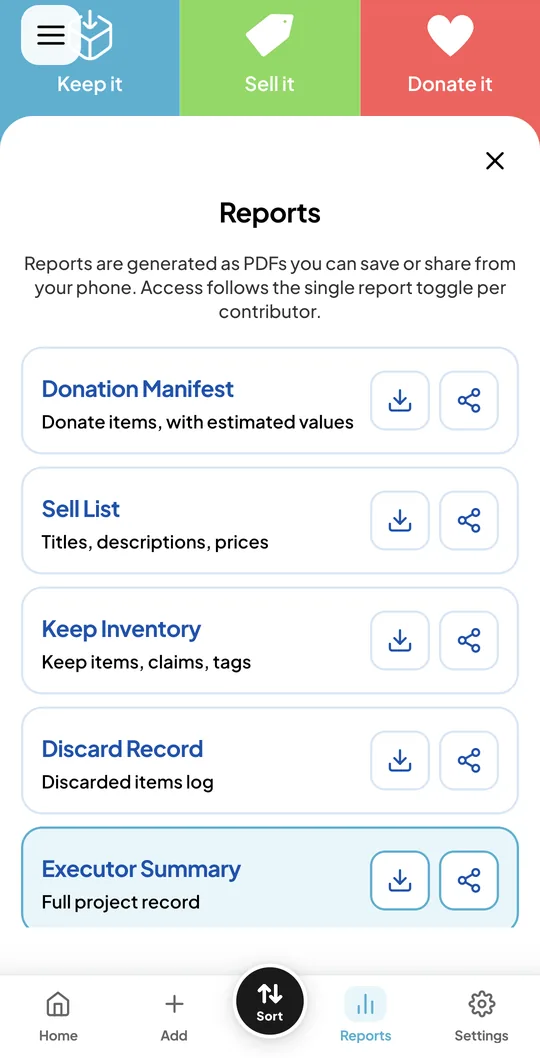
Keep a list of what you donated and any receipt. Tax treatment of donations differs by country, so ask a tax adviser if it matters to you. In Keep it, Sell it, Donate it you can save a PDF Donation Manifest that lists the items you donated, with estimated values.

Quick checklist

  • Decided what is worth selling and what to donate
  • Checked what your chosen charity accepts
  • Cleaned, sorted and packed everything
  • Left out broken, stained or recalled items
  • Photographed and listed what you gave
  • Booked a pickup or planned a drop-off
  • Kept receipts and a record of the donation

Make it easier

Track what you donate, with a record for your files

Keep it, Sell it, Donate it lets you photograph each item and tag it Keep, Sell, Donate or Discard. It keeps a list of everything you donate, with estimated values, and saves a PDF Donation Manifest.

Get it onGoogle Play Coming soon to theApp Store
Reports screen listing the Donation Manifest, Sell List, Keep Inventory, Discard Record and Executor Summary

Frequently asked questions

How do I donate household items?

Check what your chosen charity accepts, clean and sort your items, pack them, and then either drop them off or book a household donation pickup. Keep a list of what you gave, and a receipt if you get one.

What household goods can I donate?

Charities generally accept clean, working and complete items such as furniture in good condition, kitchenware, small appliances that work, linens, lamps, tools and books. Each charity has its own list, so check before you donate.

Where can I donate home items?

You can donate home items to charity shops, charities that offer household donation pickup, shelters, community groups, schools and local reuse centres. Call or check the website first, because each place accepts different things and some are not able to take furniture or bulky goods.

Can I donate kitchen items and small appliances?

Yes, if they are clean, complete and working. Leave out chipped or very worn dishes, wrap knives safely, and check that appliances have their cords and parts. Call ahead to ask what the charity accepts.

Does the Salvation Army pick up household items?

The Salvation Army offers household donation pickup in many areas, but availability and what they accept depend on your location. Check their website or call your local centre to find out what is offered near you.

Should I sell or donate unwanted items?

Sell items that are worth more than the effort of listing and handing them over, such as valuable furniture or collectibles. Donate the rest. If you are unsure whether something is valuable, get it checked first.