Keepit Sellit Donateit
← Back to home

Guide

Downsizing checklist: what to keep, sell and donate

To downsize, measure your new space first, then sort your belongings room by room into keep, sell, donate or discard, starting with the rooms you rarely use. Decide sentimental items together with family, get valuables appraised before selling, donate or dispose of the rest, and ask for help if it starts to feel like too much.

Downsizing means fitting the life you have into a smaller space, and deciding what to do with everything that will not fit. It is practical work, but it is also emotional, because belongings carry memories. This checklist gives you a calm order to work in.

This is general information. For help with a move, see our guide to making a moving inventory list.

Step 1: Know your new space

Downsizing is much easier when you know what you are downsizing to. Measure each room, the storage space and the doorways and stairs. Sketch a simple floor plan and mark where your must-have furniture will go. Then set a target, such as "what fits comfortably" or "about half of what I have now".

Step 2: Set your rules

Rules turn hundreds of small decisions into one repeated question. For each item, ask:

  • Do I use it?
  • Do I love it?
  • Will it fit in the new space?
  • Would someone in the family want it?

If the answer to all four is no, it is a sell, donate or discard. Duplicates are the easiest place to start: you rarely need three of anything. Work one room at a time and stop when you are tired. Downsizing is a marathon, not a sprint.

Step 3: Start with the easy places

Begin where there is the least emotion and the most clutter: the garage, attic, shed, storage unit and spare rooms. Then move on to the kitchen, bathrooms and wardrobes. Save the living areas and anything sentimental for later, when you have built momentum.

Step 4: Handle sentimental items

This is the hardest part. Learning to declutter sentimental items is mostly about keeping the memory and letting go of the object. A few approaches help:

  • Make a memory box of a set size, and keep only what fits.
  • Keep one, photograph the rest. For collections, such as ten teddy bears, keep the best three and photograph the others.
  • Scan photographs, letters and papers so the memory travels without the paper.
  • Use a "maybe" box. Tape it shut, write a date six months ahead, and review it then. If you have not opened it, you can usually let it go.
  • Let things go to people who will use them. It is easier to part with an item when it has a good home.

Step 5: Involve your family

Offer items to children, grandchildren and close friends before you sell or donate them, and give a clear deadline so things do not sit around. Photograph what is on offer and share the list, so people who live far away can have their say. In Keep it, Sell it, Donate it, each person can vote on every item from their own phone.

If you are an adult child helping a parent downsize, remember that it is their home and their belongings. Ask before moving or discarding anything, let them make the decisions, and be patient with the memories that come up.

Step 6: Sell what has value

  • Get valuables looked at first. Antiques, jewellery, art, instruments and collections can be worth more than they look. Get a valuation or a second opinion before selling.
  • Sell everyday items online or locally. Clear photos and honest descriptions help, and so does a fair price. Second-hand furniture often sells for less than people expect.
  • Consider an estate-sale company if you have a whole house of items to sell. They usually take a share of the proceeds, so ask about fees in writing.

Step 7: Donate what is usable

For a full walkthrough, see our guide to donating household items.

  • Charities generally want items that are clean, working and in good condition. Check what each one accepts.
  • Many charities offer household donation pickup, so ask when you book. Some will collect furniture and appliances.
  • Keep a list of what you gave. Tax treatment of donations differs by country, so ask a tax adviser if it matters.

Step 8: Dispose of the rest properly

If something is not good enough to sell or donate, you still have options.

  • Old furniture and large items (see our guide to getting rid of old furniture): ask your local council or waste service about bulky-item collection, take it to a recycling centre, or list it as "free to collect" online. A clearance service will remove it for a fee.
  • Mattresses and appliances: rules vary by area, so check with your local waste service before putting them out.
  • Paint, chemicals, batteries and old medicines: take them to a proper disposal point, not the bin.

Step 9: Get help if you need it

Senior move managers and downsizing services help with planning, sorting, selling, packing and setting up the new home. They can be a big relief when a move is large or emotional. Costs vary, so get a written quote, ask for references, and look for a professional association's member directory. See our guide to senior move managers and downsizing help for seniors. You do not need to do it all alone.

Quick checklist

  • Measured the new space and drawn a simple floor plan
  • Set a target and four simple questions for every item
  • Started with the garage, attic and spare rooms
  • Set up a memory box and a "maybe" box
  • Offered items to family with a clear deadline
  • Valued anything that might be valuable before selling
  • Booked charity pickups for donations
  • Arranged proper disposal for the rest
  • Asked for help where the job felt too big

Make it easier

Sort every room, with your family's help

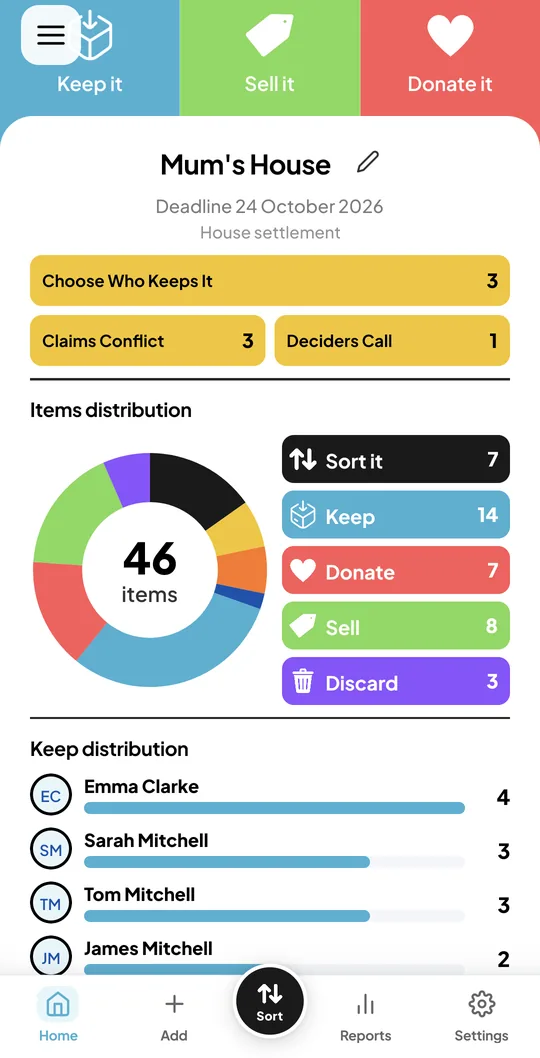
Keep it, Sell it, Donate it lets you photograph each item, tag it Keep, Sell, Donate or Discard, and invite family to claim what they want. It tracks what sells and what you donate, and saves PDF records when you are finished.

Get it onGoogle Play Coming soon to theApp Store
Project dashboard showing 46 items split into Keep, Sell, Donate and Discard, and how many items each person is keeping

Frequently asked questions

Where do I start when downsizing?

Start by measuring your new space so you know how much you can keep. Then begin with the easiest places, such as the garage, attic and spare rooms, and work one room at a time. Leave sentimental items for later.

How do I downsize a lifetime of belongings?

Break it into small, regular sessions. Ask the same four questions of every item: do I use it, do I love it, will it fit, and would someone in the family want it. Keep a memory box for sentimental pieces and use a maybe box for decisions you are not ready to make.

What should I do with furniture that will not fit in my new home?

Offer it to family first, then sell it if it has value, donate it if it is in good condition, or arrange proper disposal. Ask your local council or waste service about bulky-item collection, and check whether charities offer furniture pickup.

How can I help my parents downsize without upsetting them?

Remember that it is their home and their decision. Ask before moving or discarding anything, start with low-emotion areas, work in short sessions, and make space for the stories that the belongings bring up. Photographing items for family to claim can make it easier to let things go.

How do I decide what sentimental items to keep?

Keep what you use, love or can display, and photograph the rest. Use a memory box of a set size, and a maybe box you review in six months. Offering items to family first makes it easier to let things go.

Is it worth hiring a senior move manager?

It can be, especially for a large home, a tight deadline or a stressful situation. Ask what services are included, get a written quote and references, and compare it with the cost of doing parts of the job yourself.