Keepit Sellit Donateit
← All guides

Guide · Decluttering

How to declutter sentimental items without regret: 7 steps

To declutter sentimental items, gather them in one place, sort them into keep, pass on, photograph and let go, and a 'not sure yet' box, then give the keepers one limited home such as a single box or shelf. Start with the easy things, decide by meaning rather than guilt, and revisit the 'not sure' box after a few weeks. You are keeping the memory, not every object attached to it.

Sentimental things are the hardest to sort, because the question is never really about the object. A child's drawing, a ticket stub or a grandparent's teacup stands in for a person, a place or a time you do not want to lose. That is why a normal 'does it spark joy' sweep stalls the moment you pick up the first card.

This guide gives you a gentler method. You will keep what matters, find kind ways to let the rest go, and stop the pile from growing back. If you are working through a relative's home, our downsizing checklist covers the wider job, and this guide goes deeper on the emotional part.

Step 1: Pick a good moment and start small

Do not begin with the attic full of a lifetime. Choose a time when you are rested and not rushed, and start with something low stakes such as a drawer of old cards, a box of ticket stubs or a shelf of knick-knacks. Early wins build the confidence you need for the harder boxes.

Set a time limit of an hour or two. Emotional decisions are tiring, and the later ones in a long session are usually worse than the early ones. Stop while you still feel steady.

  • Choose one category at a time: photos, letters, children's artwork, clothing, jewelry, trinkets.
  • Keep a glass of water, tissues and a bin bag nearby.
  • Tell the people it affects before you start. A partner or sibling may care about an item you assumed was only yours.

It is normal to feel sad, nostalgic or guilty. Those feelings do not mean you are making a mistake. They mean the things matter to you, and they pass faster than most people expect.

Step 2: Gather everything of one kind in one place

Sentimental things hide in every room, which makes the pile look smaller than it is. Collect everything in one category onto a table or bed so you can see the real amount. Seeing twelve nearly identical baby blankets or fifty school reports makes the decision clearer than looking at one.

Then sort by type. Photos with photos, letters with letters, clothing with clothing. Comparing like with like lets you pick the best of each instead of keeping everything by default.

As you work, use four labeled boxes or spots on the floor:

  • Keep: the items that truly matter.
  • Pass on: things someone else would love, or that can be sold or donated.
  • Photograph and let go: items whose value is the memory, not the object.
  • Not sure yet: a small box for the ones you cannot decide today.

Anything that is broken, damaged or truly useless goes in a separate bag for the bin. Be honest about it, and be gentle with yourself about the rest.

Step 3: Decide by meaning, not by guilt

Guilt is the main reason sentimental clutter builds up. We keep a gift because the giver might ask about it, or a relative's ornament because throwing it out feels disloyal. The memory is not stored in the object, and your love for a person does not depend on the vase.

Try these questions on each item:

  • Does it connect me to a person or moment I truly want to remember?
  • Would I miss it if it were gone, or only feel guilty?
  • Is it already a duplicate of something that tells the same story?
  • Do I look at it or use it, or does it only sit in a box?
  • If I kept just one thing from this group, which would it be?

The last question is powerful. Choosing one or a few pieces to stand for a memory often lets you release the rest without feeling you have lost anything. One strong teapot, scarf or letter can carry more meaning than a drawer of leftovers.

If you inherited the item, you are allowed to decide it is not for you. Offer it to relatives first, and let go of the rest without shame.

Tip: Photograph each sentimental item in Keep it, Sell it, Donate it, add the story in the notes, and vote Keep, Sell, Donate or Discard so the memory is saved even when the object moves on. Try the free app.

Step 4: Photograph and let go

Taking a picture is one of the kindest ways to release something that is bulky but meaningful. A photo keeps the shape, color and look of the item, and often the story too, without the shelf space.

  • Children's artwork: photograph each piece, perhaps with the child holding it, and keep one favorite per school year.
  • Clothing and costumes: photograph the outfit, and keep a single piece, such as a christening gown or a favorite jacket, or cut a patch from a quilt.
  • Trophies and certificates: a photo of the shelf or the certificate preserves the achievement.
  • Letters and cards: scan the ones that matter and keep a handful of the very best.
  • Old photos: scan them and back the files up in two places. Our guide to old family photos goes into the detail.

Add a short note about who it belonged to and why it mattered, and store the photo with your other family records. The story is often the real treasure, and it is the part most easily lost.

Once the photograph is saved and backed up, the object is free to go. Donate it, pass it to someone who will use it, or recycle it.

Step 5: Pass things on to people who will love them

Letting go is far easier when you know the item is going somewhere good. A cousin may treasure the cake stand, a young relative may wear the watch, a local museum or historical society may want old letters or uniforms.

  • Family and friends: offer an item with its story. 'This was your grandmother's and she used it every Sunday' makes the gift mean something.
  • Charity: clean, usable items can be donated. Our guide to donating household items explains what charities usually take.
  • Sell: if something has real value, a sale can fund something your family will enjoy. See how to sell antiques and collectibles.
  • Repurpose: turn a collection of t-shirts into a quilt, or frame a handful of postcards.

If several family members want the same thing, talk early and kindly, and agree a fair way to choose. Our guide on when siblings want the same item gives practical options.

Do not push items onto relatives who do not want them. Handing your clutter to someone else just moves the problem and can strain the relationship.

Step 6: Set a limit and make a keep box

The keepers need a boundary, otherwise the pile creeps back. Give each category a fixed home, and let the container set the limit.

  • One sturdy memory box per person in the household, or per category.
  • One shelf or drawer for family mementos.
  • One album or frame wall for displayed photos.

When the box is full, something has to leave before something new goes in. This rule sounds strict, but it makes future decisions easier because the answer is built in.

Choose archive-quality containers if the items are fragile, and store them somewhere dry and temperature-stable rather than a damp garage or a hot loft. Label each box with its contents and the date you sorted it.

Display your best pieces instead of hiding them. A framed letter, a shadow box of small pieces or a rotating shelf means you actually see the things you kept, which is the whole point of keeping them.

Step 7: Revisit the 'not sure' box and stay on top of it

Seal the 'not sure yet' box, write a date a few weeks ahead on it, and put it out of sight. When the date arrives, open it with fresh eyes. Many people find they hardly remember what is inside, and the choice is easy. If you cannot decide even then, keep the item you still love and let the others go.

Then keep the habit going lightly:

  • Review your memory box once a year, on a date you will remember.
  • Sort new keepsakes, such as school work and cards, as they arrive.
  • Use a 'one in, one out' rule for sentimental categories.

If you are sorting a loved one's home after a death, there is no rush to do it all at once. Take time, ask other family members, and avoid making big permanent decisions in the first weeks of grief. Our guide to clearing out a parent's house and advice on a parent's jewelry help with the larger job.

Quick checklist

  • Picked a calm moment and a time limit
  • Started with a low-stakes drawer or box
  • Gathered one category in one place
  • Set up keep, pass on, photograph and let go, and not-sure boxes
  • Photographed and backed up items before letting them go
  • Offered family items to relatives, with the story
  • Gave the keepers one limited home
  • Dated the not-sure box and set a review reminder

Sorting memories with family?

Keep the story, share the decision

Keep it, Sell it, Donate it lets you photograph each item with notes about its story, then everyone votes Keep, Sell, Donate or Discard on their own phone. If two people want the same item, it becomes a Claims Conflict that you can talk through together.

Families in Australia, the USA and Europe already use Keep it, Sell it, Donate it as their tool for decluttering and sorting a home together. It is free to start, with no credit card needed.

Get it onGoogle PlayComing soon to theApp Store
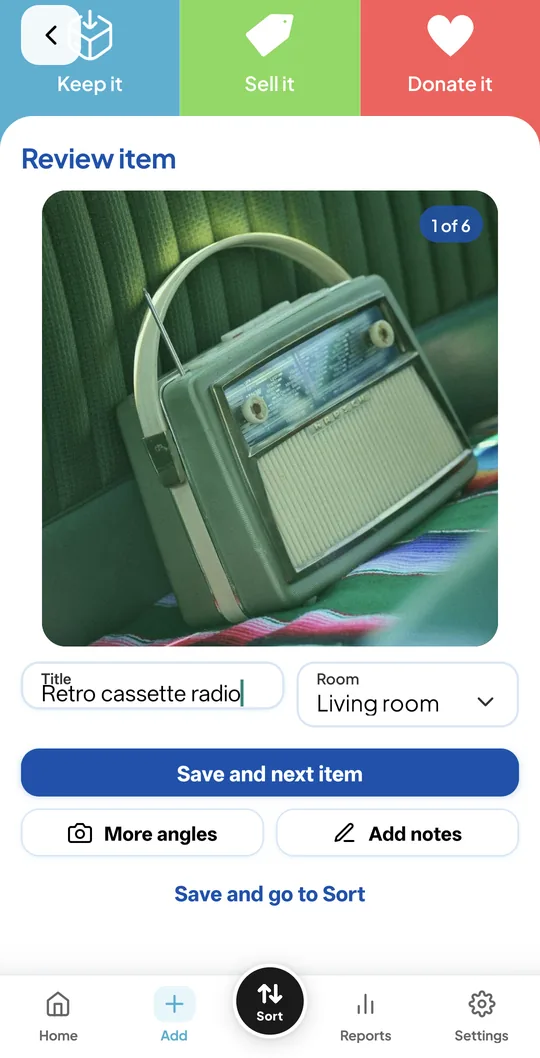
Phone screen reviewing a photo of a retro cassette radio with a title and room field

Frequently asked questions

How do I declutter sentimental items without feeling guilty?

Remember that the memory lives in you, not in the object. Keep the pieces that truly connect you to a person or moment, photograph the rest, and pass items on to someone who will use or treasure them. Guilt usually fades quickly after the decision.

What is a keep box and how big should it be?

A keep box is one sturdy container for your most meaningful keepsakes. Size it to your space, for example one shoebox or one storage tub per person. When it is full, something must leave before something new goes in.

Is it okay to throw away sentimental items?

Yes. If an item is damaged, duplicated or only causes guilt, letting go is fine. Photographing it first, or saving a single piece to represent the memory, helps many people feel at peace with the choice.

How do I decide what to keep from a loved one who has died?

Take your time and avoid rushing in the first weeks. Choose a few items that truly remind you of them, ask other relatives what they would like, and photograph the rest. Check the will and speak to the executor before disposing of anything valuable.

What should I do with sentimental items I cannot decide about?

Use a 'not sure yet' box. Seal it, date it a few weeks ahead and store it out of sight. When you reopen it, many items feel easier to release, and the ones you still love can go to your keep box.

How do I declutter my children's artwork and school papers?

Photograph each piece, keep one or two favorites per school year in a labeled box, and display a few on the wall for a while. Involving your child in choosing the favorites makes the process kind and easy.