Keepit Sellit Donateit
← All guides

Guide · Decluttering

How to declutter your house fast: a realistic weekend plan

To declutter your house fast, sort every room with four boxes (Keep, Sell, Donate, Discard), work from the easiest rooms to the hardest, and clear each pile out of the house the same day. A weekend is enough for a small home if you plan the rooms first, set time limits and take breaks. A larger home is easier to handle over about a week.

Most people try to declutter fast because something is coming: guests, a viewing, a move, a new baby or simply a day when the mess became too much. The trouble is that fast decluttering usually fails in the same two ways. Piles pile up in the hallway because nobody planned where they go, and the sorting stalls on tricky items.

This plan fixes both. It gives you a simple sorting system, a room order that builds momentum, and a same-day exit for every pile. It works over one weekend for a small home, or over a week of evenings for a bigger one.

This is general information, not legal, tax or financial advice. Rules differ by country, state and charity, so check the details that apply to you.

Step 1: Plan before you pick anything up

An hour of planning saves hours of wandering. Before you start, write a list of every room, closet and storage space. Next to each, put a rough time. A bathroom may need 30 minutes, a kitchen two hours, a garage half a day. Add them up and be honest about whether it fits your weekend. If it does not, spread the list over a week or drop the lowest-priority spaces.

Then prepare:

  • Take a quick photo of each room as a before picture. It helps motivation and records what was there.
  • Get supplies: large bags, four boxes or bins, tape, a marker, cleaning cloths and a loud timer.
  • Check your exits ahead of time: charity drop-off hours, a bulky waste booking, a local marketplace group, a skip or a hired van.
  • Arrange for small children or pets to be elsewhere for some of it, if you can.

Fast does not mean frantic. Plan meals, water and rest breaks, or your energy will drop by midday on day one.

Step 2: Use four boxes: Keep, Sell, Donate, Discard

The four-box method is popular because it forces a decision on every item. Label four containers and add a fifth bag for things that belong in another room.

  • Keep: things you use, need or truly love, and that have a home.
  • Sell: items with real resale value that you are willing to list this week.
  • Donate: clean, working things someone else can use.
  • Discard: broken, stained, expired or unusable things, plus recycling.
  • Relocate: things that are fine but live elsewhere. Put them away at the end of each room, not during.

Ask quick questions: Have I used this in the last year? Would I buy it again? Do I have a better one? Does it have a place? If you have to think for more than about 30 seconds, move on.

A fifth, smaller box can be helpful: 'Decide in 30 days'. Seal and date it, and bin whatever you have not needed by then. It stops one hard item from slowing the whole room.

Be realistic about Sell. If you will not list it within a week, move it to Donate.

Step 3: Work in the right room order

Start where the payoff is quick and the emotions are low, then move toward the harder rooms. This builds momentum and shows quick progress.

  1. Entryway and living room surfaces: mail, shoes, coats, remote controls, magazines. Visible wins lift your mood.
  2. Kitchen: expired food, duplicate utensils, unused gadgets, mismatched containers.
  3. Bathrooms: expired products, old towels, half-used bottles.
  4. Bedrooms and wardrobes: clothes you have not worn in a year, shoes, bedding.
  5. Kids' rooms: toys and outgrown clothes. Our guide on decluttering kids' toys helps.
  6. Home office and papers: shred, recycle or file.
  7. Storage areas and garage: save these for last, because they take the longest. See how to declutter a garage.
  8. Sentimental items: leave these until the end, when you are in the swing of it. See how to declutter sentimental items.

Finish one room before starting the next. A half-sorted house looks worse than an untouched one, and it makes the work feel endless.

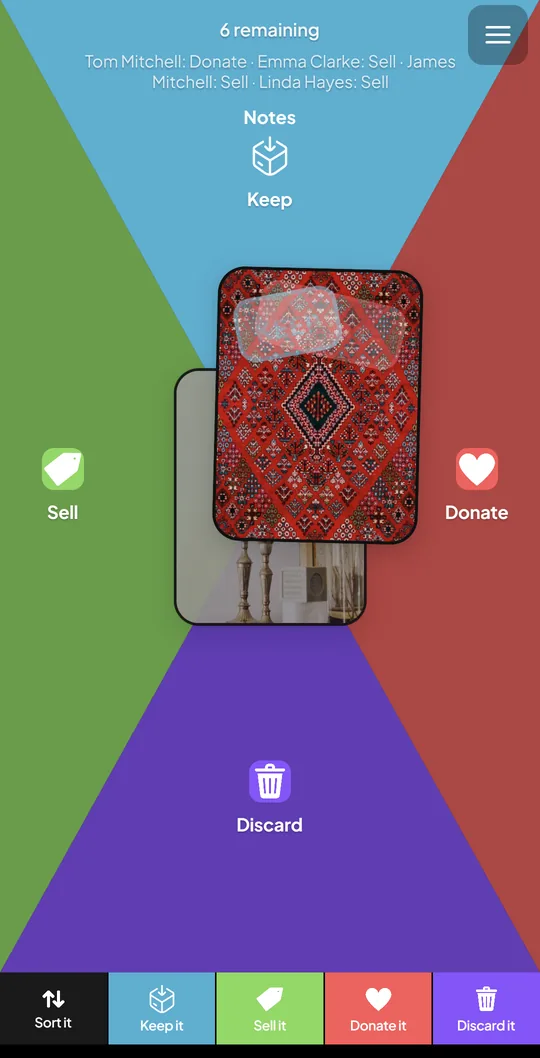
Tip: Photograph the items as you sort, then vote Keep, Sell, Donate or Discard in Keep it, Sell it, Donate it, so the piles and the sell list match what is actually leaving the house. Try the free app.

Step 4: A realistic weekend schedule

Here is a sample plan for a two to three bedroom home. Adjust it to your own size and energy.

  • Friday evening (1 hour): plan the list, gather supplies, take before photos, book any collection or drop-off.
  • Saturday morning (3 to 4 hours): entryway, living room, kitchen. Take a lunch break away from the mess.
  • Saturday afternoon (3 hours): bathrooms and the first bedroom. Run the first donation and disposal trip before dinner.
  • Sunday morning (3 to 4 hours): remaining bedrooms, kids' rooms, office.
  • Sunday afternoon (2 to 3 hours): storage areas, a final sweep, the last trips, and listing items for sale.

A single weekend will not finish a large house, a garage full of tools or a lifetime of paperwork. That is fine. Set an honest goal such as 'the whole living area, kitchen and bedrooms', and put the rest on a second weekend.

If you have only evenings, give yourself one room or one big area per night over a week. Ninety focused minutes beats a whole day of half-attention.

Step 5: Clear every pile out the same day

The piles are where fast decluttering falls apart. A heap of donation bags in the hall quickly becomes a new kind of clutter. Move each pile out of the house before you go to bed, or at least into the car.

  • Discard: bag it and put it in the bin, or take it to the recycling and waste center. Bulky items may need a booked collection, so check your council's rules.
  • Donate: load the car and drop it off the same day. Call ahead to check what is accepted. Our guide to donating household items explains what charities usually take, and what you cannot donate saves you a wasted trip.
  • Sell: photograph and list the best items within a day or two. For larger things, see how to sell furniture online. Set a deadline: whatever has not sold in two weeks gets donated.
  • Keep: put each item in a real home before you finish the room, or it will end up on a surface again.

If you have a lot to haul, a hired van or junk removal service can take it all in one go. Quotes vary by area, so ask for two or three.

Step 6: Handle the tricky items without losing time

A few categories slow everyone down. Have a rule ready for each.

  • Sentimental things: do not decide in the middle of a speed session. Put them in a labeled box and come back later.
  • Gifts you dislike: a gift has already done its job. Pass it on without guilt.
  • 'Just in case' items: if it is cheap to replace and you have not used it in a year, let it go.
  • Expensive things you regret buying: the money is gone either way. Selling it is better than keeping it as a reminder.
  • Other people's things: never throw away a partner's, housemate's or child's things without asking. Put them in their own box and let them decide.

Paper, batteries, paint, electronics and chemicals may need special disposal. Do not put them in the household bin. Check your local council or waste authority for drop-off options, and keep them aside for a separate trip.

Step 7: Finish with a reset, and keep it that way

When the last bag is gone, wipe surfaces, vacuum and put things where they belong. Take an after photo of each room and compare it with the before one. It is a surprisingly good reward.

To stop clutter returning quickly:

  • One in, one out: when something new comes in, something old leaves.
  • A weekly ten-minute reset: clear surfaces and put things away.
  • A donation bag: keep one in a closet and fill it throughout the year.
  • A monthly look at the 'decide in 30 days' box.

If you are decluttering because a move or a sale is coming, our moving timeline checklist shows how the decluttering fits into the bigger plan. If you are helping an older relative, see decluttering for an elderly parent, where speed is less important than patience.

Quick checklist

  • Listed every room and estimated the time
  • Took before photos of each room
  • Prepared four boxes, bags, tape and a timer
  • Booked donation drop-off, collection or a van
  • Worked easy rooms first and hard rooms last
  • Cleared every pile out the same day
  • Set a two-week deadline for items to sell
  • Left sentimental items for a separate session

Decluttering with others?

Sort faster with a clear list

Keep it, Sell it, Donate it lets you photograph items room by room and vote Keep, Sell, Donate or Discard. Invite your family or housemates so each person votes on their own phone, and use the reports to see what is leaving and where it goes.

Families in Australia, the USA and Europe already use Keep it, Sell it, Donate it as their tool for decluttering and sorting a home together. It is free to start, with no credit card needed.

Get it onGoogle PlayComing soon to theApp Store
Swipe screen with a photo of a rug and zones for Keep, Sell, Donate and Discard

Frequently asked questions

How can I declutter my whole house in one weekend?

Plan the rooms on Friday, then use four boxes (Keep, Sell, Donate, Discard) and work from the easiest rooms to the hardest. A small home can be done in a weekend. Larger homes usually need a second weekend or a week of evenings.

Where should I start when decluttering a house?

Start with the entryway, living room surfaces and kitchen, where the payoff is quick and the emotions are low. Leave storage areas, paperwork and sentimental items until later, when you have momentum.

What is the four-box method for decluttering?

You label four boxes: Keep, Sell, Donate and Discard, and make a quick decision on each item. Some people add a 'relocate' bag for items that belong in another room and a dated 'decide in 30 days' box.

How do I get rid of the piles after decluttering?

Plan the exits first and move each pile out the same day. Bin or recycle discards, drop donations at a charity that accepts them, and list sale items within a day or two. Move whatever has not sold after two weeks into donations.

How long does it take to declutter a house?

It depends on size and how much you own. A small home can take a focused weekend, while a larger home or a garage full of items may take a week or more. Plan time per room and add buffer for breaks and trips.

How do I declutter when I feel overwhelmed?

Start with one drawer or one surface and set a 20 to 30 minute timer. Small wins build momentum. Skip emotional items for now, and take breaks. Many people find it easier with a friend or family member helping.