Keepit Sellit Donateit
← All guides

Guide · Decluttering

Decluttering Checklist: Room by Room, Keep, Sell or Donate

A decluttering checklist works best room by room: sort every item into Keep, Sell, Donate or Discard, finish one room before the next, and leave sentimental items until last. Start with the easy wins such as expired products and duplicates. Sell only what is worth the effort, donate what is clean and usable, and agree shared decisions with your household first.

Most people know they need to declutter, but not where to begin. A good decluttering checklist breaks a whole house into small jobs, so you always know the next step and never face the entire home at once.

This guide works for any room at any time, whether you are tidying up, getting ready to move or helping family. It also tells you what to keep, sell, donate or discard in each space. If you are moving to a smaller home, see our downsizing checklist as well.

This is general information, not legal, tax or financial advice. Rules differ by country, state and charity, so check the details that apply to you.

Step 1: Set up your declutter system before you start

Most people stall because they pick things up, put them down and never decide. A simple system fixes that. Before you touch a single drawer, set out four containers or zones labeled Keep, Sell, Donate and Discard, plus a small "not sure" box for items that need a second look.

Then follow a few ground rules that organizing sites such as Redfin and Care.com also recommend in different words:

  • Work one room, or even one drawer, at a time. Finish it before you move on, and do not shuffle items from room to room.
  • Sort by category inside the room. Do all the jackets or all the mugs together so you can see duplicates.
  • Ask simple questions. Do I use it or love it? Is it broken or incomplete? Do I own a duplicate? Would someone else use it more than I do? A common rule of thumb is that an item untouched for about a year can usually go.
  • Move the exits out the same day. A donation bag by the door and a sell box in the hallway stop piles from coming back.

Set a timer for short sessions at first. Twenty or thirty minutes on one shelf beats a whole weekend you never start. If you want a faster plan, our guide to how to declutter your house fast sets out a sprint approach.

Step 2: Declutter the kitchen

The kitchen fills up quietly with gadgets, containers and food you will never use. Start with the obvious wins, then work toward the harder calls.

  • Discard: expired food and spices, broken gadgets, plastic containers with no lids, chipped or cracked dishes, and old takeout menus.
  • Keep: the tools you reach for every week, and one good version of each.
  • Donate: duplicate utensils, extra mugs and glasses, appliances you have not used in a year but that still work, and cookbooks you never open.
  • Sell: boxed small appliances, quality cookware sets and anything that cost real money and is in good condition.

Empty one cabinet at a time onto the counter and put back only what earns its place. Wipe the shelf while it is empty, because it is the easiest moment to clean. Keep rarely used items, such as a roasting pan or a party platter, on the highest or lowest shelf rather than the prime spots.

Food needs its own pass. Check dates and use your own judgment about opened items. Unopened, in-date pantry food can often go to a food bank, but ask first about what they accept.

Step 3: Declutter bedrooms and wardrobes

Clothes are usually the biggest category in any home, so sort them by type rather than by location. Pull everything out of one wardrobe or dresser and sort it all at once.

  • Keep: clothes that fit now, that you wear, and that you feel good in. Re-sort seasonally.
  • Sell: clean items from good brands, coats, shoes and anything with the tags still on. Consignment shops and online marketplaces suit these best.
  • Donate: clean, wearable clothes and shoes in good condition. Our guide to donating household items explains what charities usually accept.
  • Discard: stained, torn or worn-out items. Textile recycling bins are often a better route than the trash, so check locally.

Do not forget the rest of the room: the floor, the chair that holds a pile, the bedside table, linens and spare bedding, and anything stored under the bed. Odd socks, single earrings and old chargers go in the "not sure" box for one last check, then out if they are still unmatched.

Judge clothes by how they fit and feel today, not by what you might become. If you are keeping something for a future version of you, set a date to review it.

Tip: Photograph each item room by room in the app, and each person votes Keep, Sell, Donate or Discard on their own phone, so nothing leaves until everyone has had a say. Try the free app.

Step 4: Declutter the living room and bathroom

The living room collects things that do not belong there: mail, remotes, throw pillows, old magazines, extra furniture and decor you stopped noticing. Decide how you want the room to feel and what you actually do in it, then remove whatever does not serve that.

  • Discard: dead remotes, expired batteries, stacks of old magazines and broken decor.
  • Donate or sell: spare chairs, lamps, shelves and books. Bulky furniture that still sells is worth a listing, and our guide to getting rid of old furniture covers the rest.
  • Keep: what you use or truly love, with a place for each thing.

In the bathroom, start with expiry dates. Throw away expired cosmetics, old razors, empty bottles and products you have not touched in months. Medicines need care: the US Food and Drug Administration says the preferred route is a drug take-back location or mail-back program, and gives separate steps if none is available. Outside the US, ask a local pharmacist.

Keep daily-use products together and store spare stock in another spot. Anything half-used and unloved goes in the Discard box without guilt.

Step 5: Declutter the garage, shed, attic and paperwork

These are the places where things go to wait, so they can hide years of decisions you never made. Take them one zone at a time, and do not start when it is nearly dark or raining.

  • Garage and shed: discard broken or rusted tools, empty boxes and dried-up paint. Paint, solvents, fuels and chemicals usually need special disposal, so check your local household hazardous waste program. Sell or donate working tools, bikes and sports gear. Our garage decluttering guide goes into more detail.
  • Attic and storage: bring boxes down, open each one and decide on the spot. If you have not opened a box in years and cannot remember what is in it, that is a strong hint.
  • Paperwork: sort mail by action and due date, then keep, scan or shred. Redfin suggests limiting paper sessions to short blocks so they do not swallow a day. Tax, property, insurance, medical and legal papers have their own retention rules, so check with an accountant or the issuing office before shredding anything important.

Photograph anything you are unsure about before it leaves. A photo gives you a record and takes much of the sting out of letting go.

Step 6: Decide what to sell and what to donate

Not everything that can be sold should be. Selling takes time: photos, a listing, messages, meetups and the occasional no-show. Use a simple test so you do not spend a weekend on a five-dollar item.

  • Sell when the item is clean, works, and is worth enough to justify the effort. Furniture, electronics, tools, quality clothing, instruments and collectibles usually qualify. Our guide to selling furniture online covers listing basics.
  • Donate when it is in good condition but would sell for little. Charities generally want clean items that work and are complete, and many refuse some categories altogether, such as damaged goods. Call or check the charity's website first.
  • Discard or recycle when it is broken, unsafe, stained or missing parts.

Set a deadline. If a Sell item has not sold in two or three weeks, either drop the price once or move it to Donate. That one rule prevents the pile from sitting in your hall for months.

If you plan to claim a tax deduction for donations, rules differ by country and change over time, so keep receipts and ask a tax professional. Our guide to keeping a donation record helps you stay organized.

Step 7: Declutter sentimental items last

Save photos, letters, gifts, children's art and family keepsakes for the end. By then you have practiced making decisions, and you know how much space you really have. Doing them first is how a decluttering weekend turns into a tearful afternoon of no progress.

  • Gather first. Bring all the mementos into one place so you can see how many there really are.
  • Set a limit. One box or bin per person is a common approach. It forces you to keep the best, not everything.
  • Keep the memory, not every object. Photograph or scan artwork, cards and small items before they go. Letting go of an object does not erase what it meant.
  • Pass things on. A relative or friend may treasure what you no longer have room for.

Be patient with yourself, and stop when you are tired. You can leave the hardest box for another day. Our full guide on how to declutter sentimental items goes through this step by step.

If the things belonged to someone who has died, there is no deadline. Take your time and involve the family before anything leaves.

Step 8: Declutter before a move

Moving is the best time to declutter, because every item you keep costs money to pack, carry and unpack. It is far cheaper to get rid of something now than to move it and then decide.

  1. Start early. Begin as soon as you know you are moving, ideally weeks before packing. Rooms you rarely use, such as the attic and spare room, come first.
  2. Work from the least used to the most used rooms. Leave the kitchen and your bedroom until last.
  3. Check the new space. Measure rooms and storage so you only keep furniture that will fit.
  4. Sell early, donate late. Listing takes lead time, while donation pickups can be booked closer to moving day.
  5. Keep a record. A photo list of what you kept, sold and donated helps with insurance and with the final inventory. See our moving house inventory list.

This guide is for any room at any time. If you are moving to a smaller home, our downsizing checklist covers the extra steps, such as choosing which furniture fits and how to handle a big space change.

Step 9: Declutter as a family with shared decisions

Decluttering a shared home goes better when everyone has a voice. Children, partners and housemates will each have different ideas of what counts as clutter, and one person deciding for everyone usually causes resentment.

  • Let people decide about their own things. Each person sorts their own room and things, with help on request. Children can fill a donation box of their own, which gives them a clear goal.
  • Agree on shared spaces. Hold a short family meeting before touching the living room, kitchen or garage.
  • Expect overlap. Two people may want the same item. Talk it through, let each person say why, and agree on a way to settle it before you start. Our guide on what to do when two people want the same item gives practical ways to decide.
  • Share the work. Give everyone a job, keep sessions short and finish with something fun.

With a group, a shared record helps. Everyone can see what is being kept, sold or donated, and nothing disappears before it has been discussed.

Quick checklist

  • Set up Keep, Sell, Donate and Discard zones plus a not-sure box
  • Declutter one room at a time and finish it before moving on
  • Clear expired food, cosmetics and medicines first
  • Sort clothes by type, not by location
  • Set a deadline for Sell items, then drop the price or donate
  • Check what each charity accepts before you drop off
  • Handle paperwork in short sessions and check retention rules
  • Leave sentimental items until last and photograph before parting
  • Agree shared decisions with the household before touching shared spaces

Decluttering with others?

Make every decision once, together

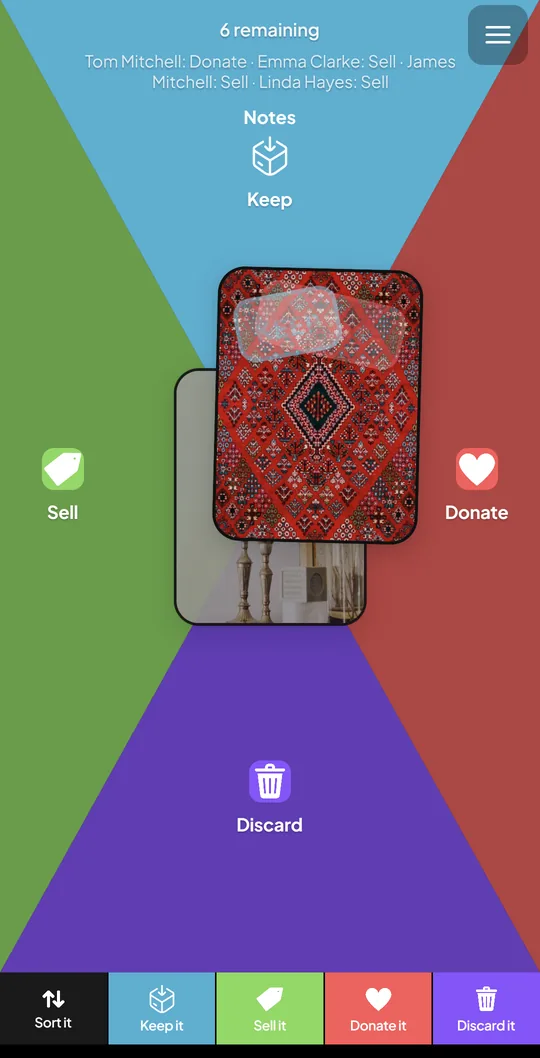
Keep it, Sell it, Donate it lets you photograph each household item room by room and invite family or housemates to vote Keep, Sell, Donate or Discard on their own phones. Nothing is decided until everyone has voted, and you end up with a clear list of what stays, sells and goes.

Families in Australia, the USA and Europe already use Keep it, Sell it, Donate it as their tool for decluttering and sorting a home together. It is free to start, with no credit card needed.

Get it onGoogle PlayComing soon to theApp Store
Swipe screen with a photo of a rug and zones for Keep, Sell, Donate and Discard

Frequently asked questions

Where should I start when I declutter?

Start with one small, low-emotion space such as a kitchen drawer, the bathroom cabinet or the hall closet. Early wins build momentum. Save sentimental items, photos and paperwork for later, when you are used to making decisions.

How do I decide what to keep?

Ask whether you use it or love it, whether it is broken or incomplete, whether you own a duplicate, and whether someone else would use it more. A common rule of thumb is to let go of items you have not used in about a year.

What is the best order to declutter a house?

Work room by room and finish each one. Many people start with the easiest rooms, such as the bathroom or kitchen, and leave sentimental items, photos and the garage or attic for later. Before a move, start with the least used rooms.

What should I sell and what should I donate?

Sell clean items that work and are worth the effort of a listing, such as furniture, electronics or quality clothing. Donate good items that would sell for little. Discard or recycle anything broken, unsafe or stained.

How do I declutter sentimental items?

Do them last. Gather them in one place, set a limit such as one box per person, photograph or scan what you can, and pass items on to relatives who want them. You can stop and come back, as there is no deadline.

How should I declutter before a move?

Start weeks ahead, begin with rarely used rooms, sell early and book donation pickups closer to moving day. Every item you keep costs time and money to pack, so decide before you pack, not after you arrive.

How do I declutter when family members disagree?

Let each person decide on their own things, hold a short meeting for shared spaces, and agree beforehand how to settle two people wanting the same item. Keeping a shared list of decisions helps everyone see what is happening.